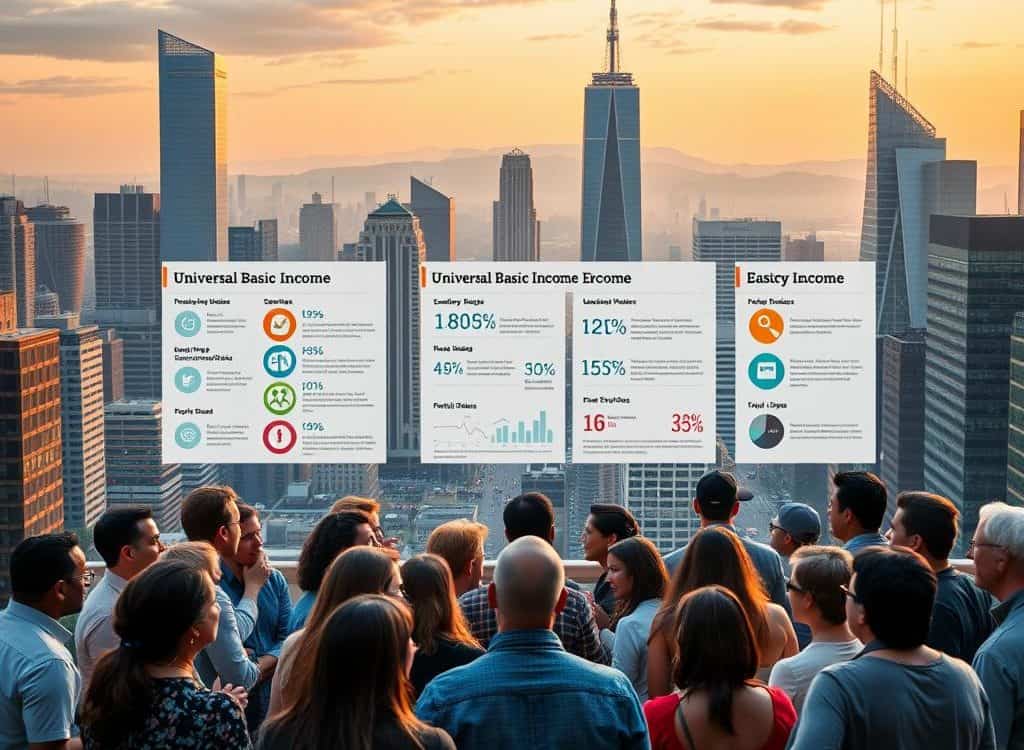
Should the Government Pay You Just for Living?
Did you know over 70% of Americans support Universal Basic Income (UBI)? This shows a growing belief that governments should help ensure everyone can live well. UBI means the government gives everyone a regular, no-strings-attached cash payment. This is different from welfare programs that have conditions.
Exploring UBI raises questions about its workability and if it can help with financial security. This is important because of growing economic gaps.
Universal Basic Income is a timely topic, thanks to automation, job changes, and demands for fairness. Yet, some worry about wasting money and the impact on taxpayers. As we discuss UBI, we must think about how it changes our views on work, value, and dignity.
Key Takeaways
- Universal Basic Income offers unconditional financial support, unlike traditional welfare programs.
- Many pilot projects, such as in Durham and Kenya, provide insights into UBI’s benefits.
- Critics argue that giving UBI to everyone, including the wealthy, may lead to inefficiencies.
- UBI could empower disadvantaged groups, like women, by giving them financial freedom.
- Various global experiments have shown promising results in poverty reduction and improved quality of life.
- There’s a significant public and political interest in UBI as a means to address inequality.
- Financial sustainability and targeting remain contentious issues in discussions about UBI’s implementation.
The Concept of Universal Basic Income
The idea of Universal Basic Income (UBI) is more than just a trend. It has a long history of basic income, starting with thinkers like Thomas More and Thomas Paine. They talked about the need for economic security. Today, UBI is getting more attention because of economic problems many face.
Definition and Origins
The history of basic income shows its roots in social philosophy. Thomas Paine proposed a basic income plan in the 18th century. Now, ideas like Andrew Yang’s “Freedom Dividend” are making UBI a topic of discussion. This plan would give $1,000 a month to those over 18, costing around $2.8 trillion a year.
Current Experiments and Global Interest
UBI is being tested in the U.S. with 67 pilot projects. Places like Stockton and Compton, California, are exploring guaranteed income to fight poverty. The idea of unconditional payments has been around for a long time, like in the Roman Empire and the Alaska Permanent Fund.
The COVID-19 pandemic has made over 90 countries consider direct cash transfers. This shows the growing interest in ensuring everyone has economic security.
The Economic Implications of UBI
Understanding Universal Basic Income (UBI) helps us see its impact on money matters and stability. As UBI talks grow, we focus on its effects on people and society. This includes how it helps reduce poverty.
Impact on Financial Security
UBI aims to make families financially secure by giving them a steady income. Studies show it could make poverty lower by replacing old welfare systems with cash. It makes getting help easier and cuts out red tape.
With UBI, people might go back to school or look for jobs. This could make the economy stronger. Experiments show UBI can improve health and school grades for young people. This helps everyone in the economy.
Concerns Regarding Economic Policy
UBI has good points, but there are worries about its money side and overall effect. Funding UBI with taxes on what we buy could be too heavy on consumers. It might mean taxes up to 25%.
This makes us wonder if UBI can last. Also, some think it might make people work less and spend more. The formal job market might grow slower if UBI replaces old support. We need to look closely at the economy to understand UBI’s real impact.

Conclusion
The talk about Universal Basic Income (UBI) is more than just giving money. It’s about the future, changing our economy, and fairness. As machines take over jobs and wealth gaps widen, we need new ways to help people. UBI might seem extreme, but tests show it can change how we see poverty and stability.
In Finland, a small monthly payment of €560 made a big difference. People felt better, were less stressed, and felt more secure. This made them want to work and learn more. It shows UBI could really help certain groups of people.
But, making UBI work is hard and needs more study. We must figure out how to pay for it and how it fits with other policies. Supporters say we should keep talking about UBI to make our economy fairer for everyone. The path to a fairer economy is just starting.

Leave a Reply
You must be logged in to post a comment.