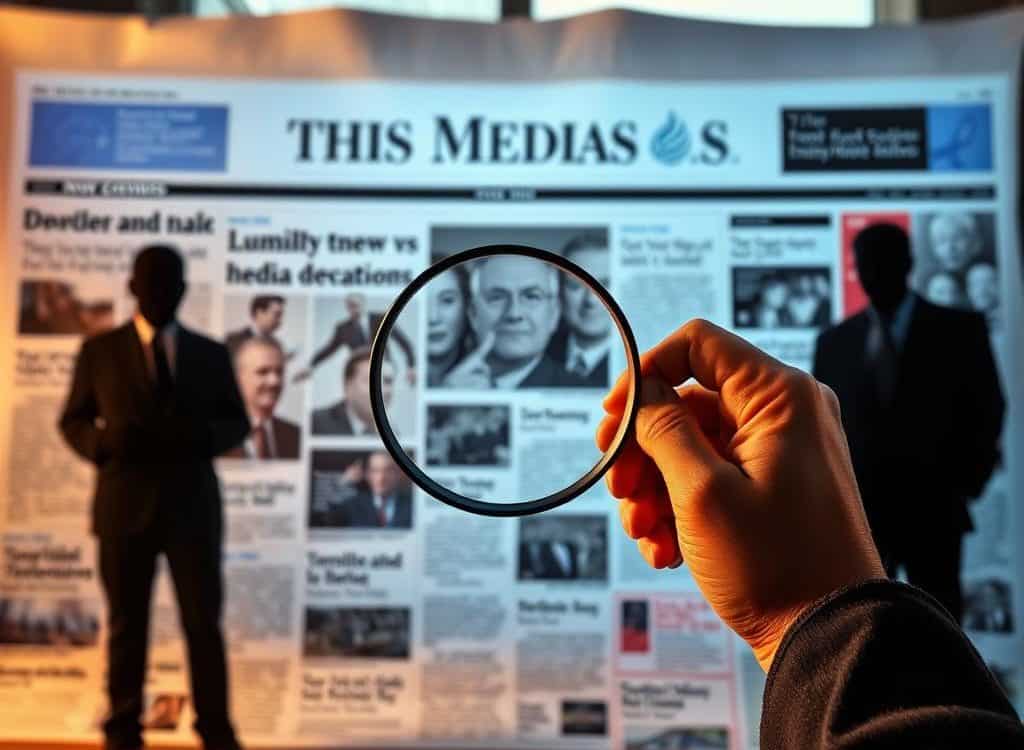
Is the News Lying to You? The Truth About Media Bias
Did you know only 31% of Americans trust the media a lot? A shocking 42% don’t trust it at all. This shows a big problem in journalism today: bias.
Reports say 67% of people who don’t trust the media blame bias, spin, and hidden agendas. As we dive into this important topic, it’s key to remember distrust is biggest among the young and those with less money.
These numbers show how media bias affects our world, filled with fake news and strong opinions. Let’s look at what’s causing trust in journalism to fade and what makes people think the media is biased.
Key Takeaways
- A significant number of Americans distrust media due to perceived bias.
- Younger individuals and those with lower incomes are most skeptical.
- Polarization grows when media seems to take sides.
- Only 24% trust social media to tell fact from fiction.
- To fight media bias, it’s important to check many sources and look at different views.
Understanding the Declining Trust in News Media
To understand the current trust in journalism, we must look at its history. Trust in media has always been key to public confidence in news. Gallup’s data shows a big drop in trust, with only 31% of Americans trusting mass media today. This is a big change from the 68%-72% in the 1970s.
This decline shows a deep crisis in journalism that has grown over years.
Historical Context of Trust in Journalism
The trust in media has changed over time, tied to big moments in American society. In 1973, most Democrats and Republicans trusted news organizations. But over the years, this trust has fallen, with just 11% of Republicans and 58% of Democrats trusting media in 2023.
The start of Fox News and MSNBC in the 1990s made news more polarized. This made it harder for people to know what to believe, adding to distrust.
Reasons Behind the Distrust
Many things have led to more doubt about media. Politics plays a big part, with 54% of Democrats trusting media and only 12% of Republicans. Age also matters, with 43% of older adults trusting media, compared to 26% of younger adults.
Media’s image has also been hurt by economic changes. Newspaper ad revenue and staff numbers have plummeted. A 2020 Pew Research Center survey found that only half of Americans trust journalists to act in the public’s best interest.
Social media has made it harder to tell real news from opinion. Many people find it hard to spot fake news, leading to less trust in mainstream media. This situation makes it harder for media to connect with the public.
Media Bias: The Perception and Reality
Media bias is a hot topic, with many arguing about what’s real and what’s seen. Some say big news groups lean too far to one side. This can mean less variety in what we hear, making some views seem more important than others.
Political Homogeneity in Newsrooms
A lot of people think news shows bias. A 2020 survey by the Knight Foundation found 80% of Americans agree. The Pew Research Center also showed a big gap in trust in news, with Democrats more confident than Republicans.
This gap shows how important diversity in newsrooms is. Without it, we might see more bias. Even big names like A. G. Sulzberger at the New York Times struggle to bring in diverse views.
The Influence of Social Media on News Consumption
Social media changes how we get our news. We’re drawn to quick, catchy headlines more than deep stories. This mix-up makes it hard to tell what’s news and what’s opinion.
College students struggle to spot bias in the sea of info. Experts like John Gable say algorithms create bubbles that limit our views. To get a balanced view, we need to seek out different sources.

Conclusion
Looking at our changing news world, it’s clear that knowing how to read the media is key. We’ve talked about big issues like how news and entertainment get mixed up. This makes it hard to know what’s real and what’s not.
With news coming fast, thanks to technology, we don’t have time to think it over. This can make reporting unfair. It’s important to understand these issues to be a smart citizen.
Dealing with fake news is a big challenge. Almost 70% of teens think news is biased. We need to learn to tell real news from fake.
By learning about media, we can fight against biased stories. This is important for young people to avoid getting caught up in false ideas.
To trust news again, we need both the media and the public to work together. Being open and talking to each other can help us understand media better. I hope we can teach people to be media savvy. This way, we can all deal with today’s big issues better.

Leave a Reply
You must be logged in to post a comment.