
Will the Metaverse Replace Real Life?
Did you know 54% of experts think the Metaverse will be a big part of our lives by 2040? This is according to a Pew Research Center survey. It shows how our digital world is changing, making virtual reality and real life closer together. Big tech companies like Meta and Google are diving into this digital world, making us wonder: Can the Metaverse replace real life, or will they just exist together?
The way we use social media and virtual reality is changing. It’s making us think about how we interact, work, and learn differently. But, this change also makes us worry about losing real human connections. In this article, we’ll look at the Metaverse’s role in our lives and the different views on its impact.
Key Takeaways
- 54% of experts predict a fully immersive Metaverse for half a billion people by 2040.
- The Metaverse promises applications in various sectors including education and healthcare.
- Concerns exist regarding isolation and the breakdown of social cohesion in the digital world.
- Virtual reality offers convenience but lacks the authentic connections found in reality.
- Major tech companies are significantly investing in extended reality technologies, highlighting industry momentum.
The Metaverse: A New Digital Frontier
The Metaverse is a big step forward in how we interact online. It combines augmented reality, virtual reality, and the internet into one big virtual world. This world is all about extended reality, which means it uses all these technologies together.
What makes the Metaverse special is how interactive and real it feels. You can make your own content and even buy and sell things in a virtual economy. It’s a place where people can come together, create, and have fun in new ways.
Understanding the Concept of the Metaverse
The Metaverse is a shared virtual space where people can do things they never thought possible. You can use augmented reality to play games or go on adventures. Or, you can dive into virtual worlds where you can shop and hang out with friends.
It works thanks to advanced tech like blockchain for safe money transactions and AI for better interactions. These tools help make the Metaverse a place where people can play games, learn, shop, and even get medical help.
Key Technologies Driving the Metaverse
Virtual reality, augmented reality, and mixed reality are the heart of the Metaverse. They make games and shows feel real and exciting, like virtual concerts and events. They also help with learning, making classes more fun and engaging.
Businesses use the Metaverse for virtual meetings and training. And in healthcare, it’s used for medical training and even remote doctor visits. These technologies are changing how we see and interact with our digital lives.
Comparison of Virtual Reality and Real Life
Virtual reality and real life have both benefits and challenges. Virtual reality lets us explore new digital worlds. It’s great for gaming, learning, and training. But, we must watch out for the risks of too much screen time and feeling disconnected from others.
Benefits of Virtual Reality Experiences
Virtual reality takes us to places we can’t go in real life. It makes learning fun and interactive. For example, it can make hard subjects easier for students to understand.
It’s also super useful in medical training. Doctors can practice without risking real patients. This helps them get better at their jobs.
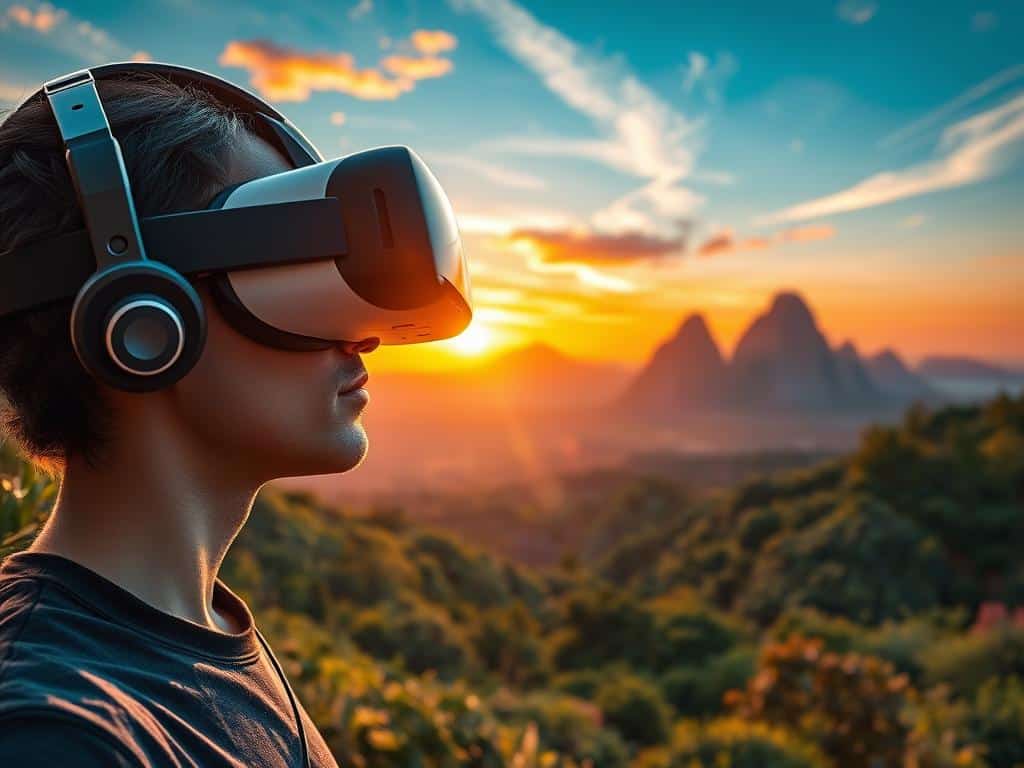
Limitations of the Digital World
But, virtual reality isn’t perfect. It can make us spend too much time online. This can hurt our ability to connect with people in the real world.
Too much time in virtual worlds can also harm our mental health. It’s important to remember the value of real-life interactions. We shouldn’t let virtual reality take over our lives.
Expert Opinions on the Future of the Metaverse
Looking into the Metaverse’s future, experts share mixed views. A Pew Research Center and Elon University survey found 624 tech experts divided. They debated the Metaverse’s role in our lives by 2040.
Experts are both hopeful and skeptical. They worry about how easy it will be for everyone to join. This could greatly affect our digital world.
Predictions for 2040
The survey shows 54% of experts think the Metaverse will become a key part of life for over half a billion people by 2040. They see a future where augmented reality (AR) and mixed reality (MR) change everything. This could impact work, school, and how we connect with others.
Experts believe AR and MR will add layers of information to our lives. This could make our world more interesting and useful. But, 46% of experts doubt the Metaverse will make such a big difference.
Concerns About Adoption and Accessibility
Despite the Metaverse’s promise, experts have big worries. They fear the psychological effects of being fully immersed. They also worry about privacy and the influence of big tech and governments.
As AR and MR spread, keeping our data safe becomes more important. Experts say we need to manage digital spaces well. This way, we can enjoy the Metaverse’s benefits while fixing current problems.
Conclusion
Looking back at our journey through the Metaverse, it’s clear this digital world is on the verge of a big change. This change could greatly alter how we interact and experience things in the future. The Metaverse is set to grow from USD 138.9 million in 2020 to USD 3,123.7 million by 2025.
This growth will likely make a big impact on how we connect with each other. It opens up new chances for innovation in social interactions, entertainment, education, and business.
But, while the Metaverse offers exciting virtual experiences, it can’t fully replace real-life interactions. The debate between reality and virtuality shows we need a balanced approach. This balance is key to enjoying both digital innovations and real human connections.
There are challenges like technical issues, privacy concerns, and the digital divide. These remind us to be careful as we move forward with these changes.
In the end, I’m cautiously optimistic about the Metaverse’s future. It has the power to add new dimensions to our lives, making them richer. By focusing on both virtual and real-world connections, we can find a way to improve our lives together.

Leave a Reply
You must be logged in to post a comment.