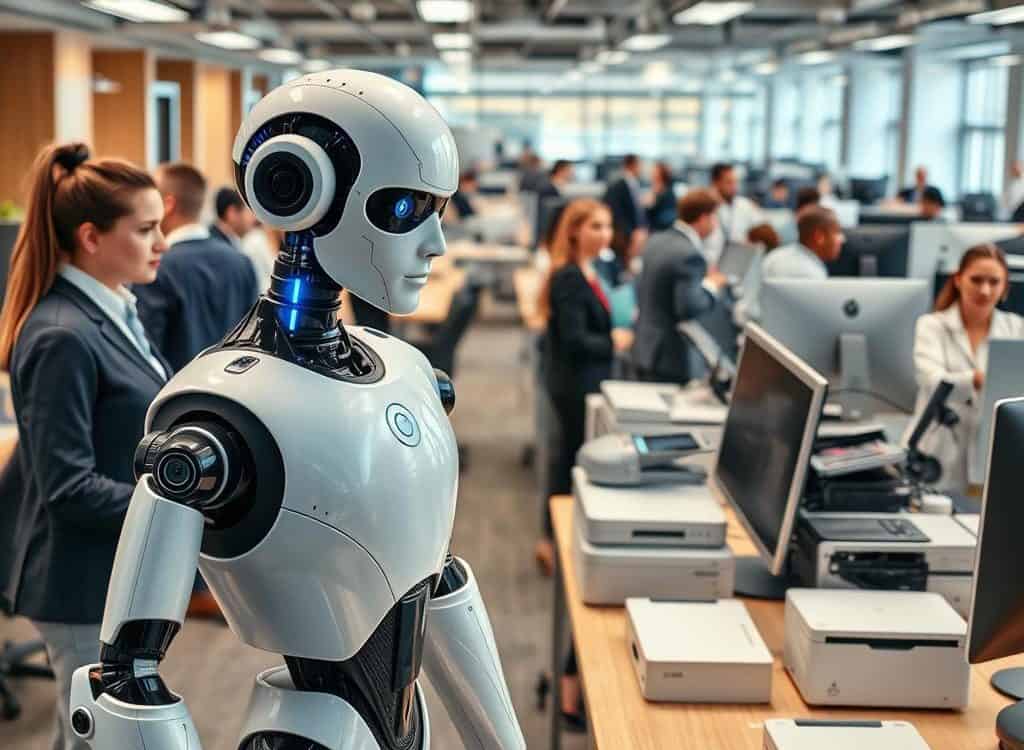
Will Robots Take Your Job? The Future of Employment
Did you know ATMs in the 1990s led to more bank branches opening? This meant more jobs for tellers, even though automation reduced the need for them in each branch. This shows how automation can both cut jobs and create new ones, a key point in today’s job security debate.
With 2 million industrial robots worldwide, mainly doing repetitive tasks, it’s important to see how they change the job market. They don’t just cut jobs; they also create new ones. This is a big part of the Future of Work discussion.
Experts have different views on whether technology is a threat or a help to our jobs. For example, robots like Sawyer work with humans, making jobs better by freeing up time for creative tasks. Experts like Pascual Restrepo and Juliet Floyd also say that skills like creativity and problem-solving are unique to humans and can’t be replaced by AI.
In a world where robots can handle uncertainty, it’s clear that many jobs are safe from automation. This means we need to focus on what makes us uniquely human. Join me as we look at how AI and automation will change our jobs and what the future of work might look like.
Key Takeaways
- Automation can disrupt employment but may also lead to job growth, similar to the impact of ATMs on banking.
- Collaborative robots enhance human roles by assisting with repetitive tasks, allowing a focus on creativity.
- The majority of deployed robots handle dangerous tasks, implying jobs remain secure in other areas.
- AI struggles with human-like reasoning, indicating many jobs involve skills that are uniquely human.
- Historical trends suggest that while jobs may be eliminated, new opportunities could emerge, necessitating adaptation.
- Philosophical reasoning and ethical reflection are irreplaceable human traits that will remain valuable in the workforce.
- Handling uncertainty is a critical aspect of many jobs, highlighting the ongoing need for human involvement.
Understanding Automation in the Workforce
Automation, led by AI and robotics, is changing the job market. These technologies bring both challenges and chances. We need to understand how they affect jobs.
The Rise of AI and Robotics
AI and robotics are changing our world. They can handle lots of data and do complex tasks well. But, they can’t replace human creativity and feelings. This shows we need to work together with machines to improve work in many fields.
Historical Context: Automation’s Past Impact on Employment
Automation has changed jobs before. For example, ATMs in the 1990s cut bank teller jobs. But, they also led to more bank branches, creating new jobs. This shows how automation can change jobs, not just cut them.
The Role of Collaboration between Humans and Robots
Working together with robots is key in today’s job world. Technology helps workers focus on harder tasks. It’s making jobs like IT and programming more important.
Companies are training their workers to work with robots. This teamwork makes work better and encourages new ideas. It’s all about working together to improve and innovate.
The Future of Work: Opportunities and Challenges
The workforce is changing fast, with both good and bad sides. Up to 800 million workers might lose their jobs by 2030 because of automation. But, new jobs will also come up, needing different skills.
Economists say some jobs will disappear, but new ones will be created. We need to get used to change and adapt.
Potential Job Losses and Gains
Automation could take over 70% of jobs in many fields. In some countries, up to one-third of workers might have to find new jobs. For example, China might see 100 million workers needing new jobs.
But, the U.S. and Germany could see more job creation. Jobs in healthcare, STEM, IT, and green energy are promising.
The Evolution of Job Roles and Skills
Many workers will need new skills by 2030. Up to 375 million workers might need retraining. Jobs that need human touch, creativity, and flexibility are safer.
Learning to adapt and get the right skills is key for job security.
Addressing Job Security in an Automated World
Job security is more important than ever. In places like Japan, the workforce is expected to shrink. We need strong education and training to prepare for the future.
Hybrid work setups could also help. They offer flexibility, which can make workers happier and more likely to stay in their jobs.

Market Dynamics and Employment Shifts
Exploring the effects of automation on work, we see that industries face different challenges and chances. Automation isn’t just about cutting jobs; it changes how we work in many fields. Industries like manufacturing, healthcare, and retail are leading this change, with big employment shifts thanks to new tech.
Industries Most Affected by Automation
Manufacturing has seen a drop in old jobs because of automation. But, this change has brought new roles focused on tech and management. In healthcare, AI is improving diagnosis, but it needs workers who know how to use these tools.
The retail sector is adapting to online shopping and automated customer service. This shows how companies must change to meet new customer needs. Automation affects jobs in both ways: some jobs disappear, but new ones emerge.
How Technology Shapes Employment Trends
Technology’s impact on employment shifts goes beyond just job names. Today, jobs are chosen based on skills, not just experience. This makes the job market more open and diverse.
Companies are now focusing on training workers for new roles. This creates chances for people to grow in their careers. With tech, work can be done from anywhere, making jobs more flexible and satisfying. The job market needs workers who can adapt quickly to new tech.
Conclusion
Looking at automation and the future of jobs, we need a balanced view. The world is changing fast, and jobs will too. But, this change can also open up new chances.
Places like NASA are already getting ready for this change. They’re updating their rules and creating a talent marketplace. This shows they’re serious about keeping up with new job needs.
It’s also key to think about the ethics of technology at work. We need laws to protect us from too much watching at work. This is important because new tech can make us feel less valued.
To deal with the future of jobs, we should see tech as a helper, not a threat. Using automation can make us feel safer and help us grow. By working together, we can make sure tech improves our lives, not just our work.
The future of work is not just about adjusting to change. It’s about finding new ways to contribute to society. Let’s use technology to make our jobs better, not just to do them.

Leave a Reply
You must be logged in to post a comment.